
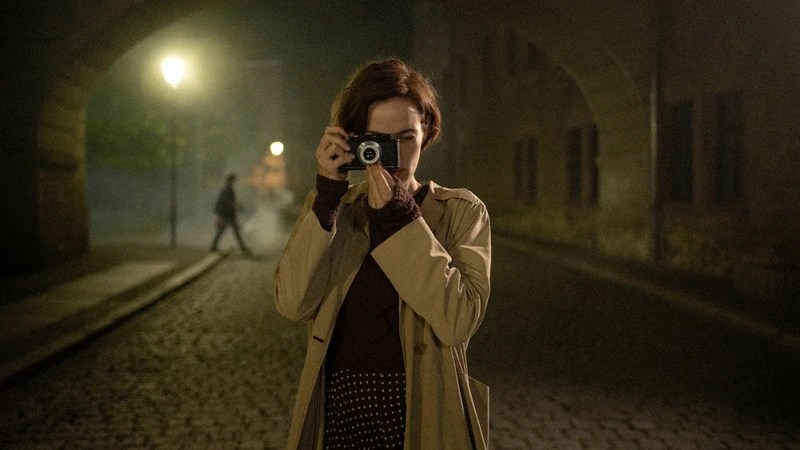
A lesser-told side of history, with a complicated woman at its center.
World premiere, opening film of Orizzonti, 83rd Venice Film Festival, 2 September 2026.
The Girl with the Leica, the opening film of the Orizzonti section at the 83rd Venice Film Festival, brings Gerda Taro to the screen: the world’s first female photojournalist to die on a battlefield. It moves the audience through mixed emotions, as it is so hard to love Gerda on screen, yet just as hard to hate her, which makes for a compelling film. There is no doubt that it leaves the audience in awe of her, for she shows resilience where many do not.
The Girl with the Leica starts in Paris on 14 July 1937, Gerda’s last day in the city before she returns to the Spanish front. Like many whose resistance against the fascist regime in Germany had failed, Gerda Taro (played by Emilia Schüle) has fled to Paris, along with the friends who share her cause. The film has her life at its center, with her relationships evolving and changing as she moves from place to place. Though she is the film’s main character, in reality she is better known as the partner of Robert Capa (played by Aaron Altaras), who went on to become one of the most celebrated war photographers of the 20th century. However, with The Girl with the Leica, Alina Marazzi unearths what truly lies behind that name: a woman who was not only the powerful force behind Capa’s success, but also a historic figure deserving of her own story. The film is loosely adapted from Helena Janeczek’s 2017 novel of the same name, which won Italy’s Strega Prize.
In telling her story, the film jumps between different timelines and covers her unorthodox life, from her political activism in Leipzig in the early 1930s to her years in exile in Paris. It also gives ample time to her romantic life. Despite her emotional unavailability and inattention, her many lovers, including Georg Kuritzkes (played by Lucas Englander) and Willy Chardack (played by Thomas Schubert), stay devoted to her throughout the film, won over by her undoubtedly charming personality. Even her best friend Ruth Cerf (played by Luna Wedler), whom Gerda neglects and looks down on at times, seems to stick by her side, and Gerda has a strong entourage that keeps supporting her.
As the film alternates between her personal life and her life as a photojournalist, the apathy she shows in her personal life turns into empathy on matters of war and politics. She is outspoken and willing to go to great lengths to show the world what happens on the battlefield. This polarity in her character plays an important role in how the film sets its tone, and brings a feeling of realness that we do not often see in films with a hero at their center. At times, however, Marazzi leans so heavily into Gerda’s careless, feminist self-assertion in her relationships that the film cannot properly land the sympathy she deserves for her achievements.
“I am an opportunist, I take everything I want.”
We follow her life from the early 1930s to 1937 and watch her career take shape, including the iconic idea she and André Friedmann, a young Hungarian photographer, came up with: reinventing themselves as Robert Capa and Gerda Taro (she was born Gerta Pohorylle), so that their work would appeal better to international audiences. The duo travel to Spain to document the Republicans’ fight against Franco’s fascist-backed forces in the Spanish Civil War, and become more famous under their new aliases as the war goes on.
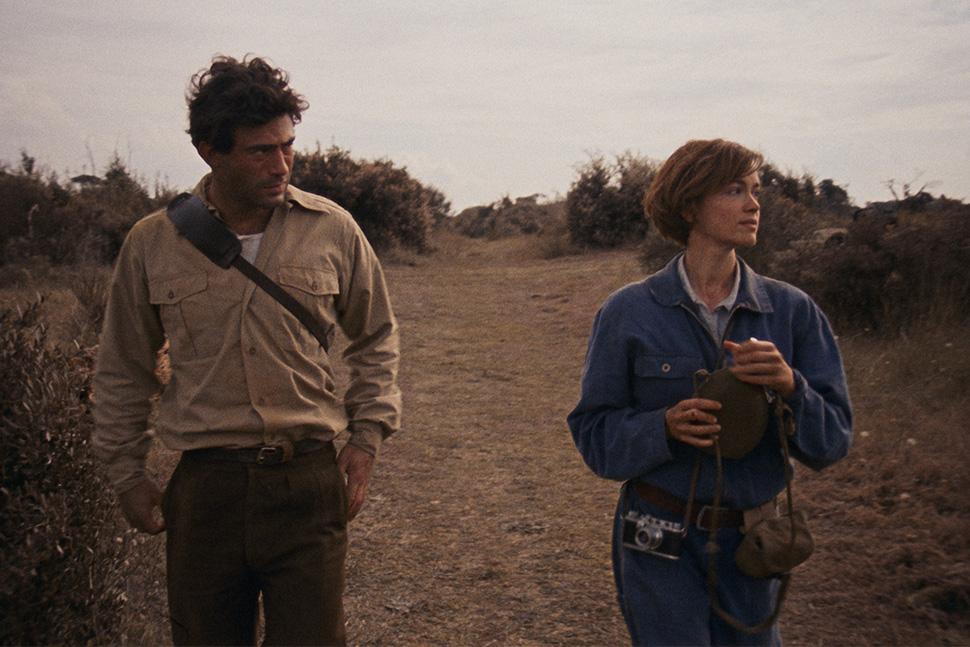
Throughout the film, Marazzi skillfully uses real photographs taken by Gerda Taro and Robert Capa, inserted naturally both within and between scenes. These archival photographs are perhaps one of the best elements of the film, reminding us of the biopic this film is. They also act as a guide, with the film moving through scenes and events, weaving the story around these photographs. And Marazzi ends the film on a strong note with a sequence of the last photos Gerda Taro took, at the Battle of Brunete, where she was killed in July 1937 at just 26. These negatives were thought to be lost for decades until they resurfaced in Mexico City in 2007.
The Girl with the Leica brings into the spotlight Gerda Taro, whose incredible story has largely been hidden behind the stories told about Robert Capa until now. Although its storytelling is unique and captivating, it sometimes fails to make the audience feel for Gerda Taro as much as the film intends. Yet Emilia Schüle does a great job of portraying the delightful, independent and brave woman Taro was, and we find ourselves invested in her untold life.
Directed by Alina Marazzi
Written by Alina Marazzi and Valia Santella, based on the novel by Helena Janeczek
Starring Emilia Schüle, Aaron Altaras, Luna Wedler, Lucas Englander, Thomas Schubert, Sebastian Schneider, Idan Weiss

Leave a comment